Peaches and Peach Pits
Straight ManPeaches and peach pits form a recurring object motif in William Henry Devereaux, Jr.’s campus life: first an unexplained cluster on his desk, then a ripe peach on the damaged blotter, and later a fruit he carries into conversations and play. Their significance lies less in any confirmed message than in the interpretations they provoke. William Henry Devereaux, Jr. treats them as clues, tests those clues against his own desires, and finds that the fruit does not settle what it might mean.
Appearance and Recurrence
The motif first appears in a strikingly specific arrangement on William Henry Devereaux, Jr.’s blotter: five peach pits sit in the center, surrounded by a dark, wet stain. The desk is part of his working environment, but the pits make it difficult to regard that environment as merely professional. They are an unexplained deposit among the messages and requests that reach him through the department, an intrusion into the ordinary order of his work. The number, placement, and stain make the fruit’s remains conspicuous without establishing who left them or why.
William Henry Devereaux, Jr. associates the pits with Meg Quigley, but only as a possibility. He wonders whether she ate the peaches and whether the remains extend a literary metaphor; he also considers whether they are a personal slight. These are competing readings, not confirmed explanations. The evidence supports the motif’s uncertainty: William Henry Devereaux, Jr. is presented with the object and then left to turn it over in thought, while its sender and intended significance remain unsettled.
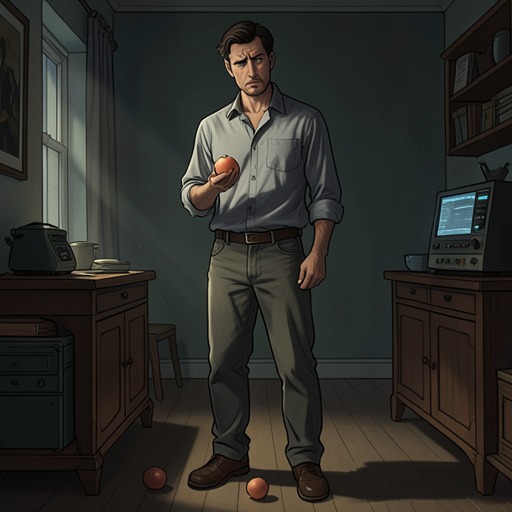
The pits are followed by a different form of the same object. During another visit by Meg Quigley, a single ripe peach sits on the ruined blotter. The change from several remains to one intact fruit makes the motif recur rather than resolve: the desk again bears an unexplained peach, but the object now appears whole. William Henry Devereaux, Jr. studies it and then slips it into his jacket pocket. The peach becomes something he carries away, not merely a puzzle left on his desk.
Interpretations and Uncertainty
William Henry Devereaux, Jr.’s speculation links the peaches to literary and personal meanings. He recalls the peach imagery associated with Eliot’s Prufrock and wonders whether the fruit suggests a daring appetite, or instead is meant to characterize him as inadequate. These interpretations are his own conjectures; the narrative does not certify either as Meg Quigley’s intention. The fruit therefore works as an open sign, capable of supporting several readings while refusing to confirm one.
The object also exposes the difference between what William Henry Devereaux, Jr. can imagine and what he can establish. His thoughts turn toward Meg Quigley and Rachel Williams, and he recognizes that his interpretations are entangled with attraction and uncertainty about his own conduct. Yet the peach pits do not prove a relationship, an invitation, or a deliberate insult. Their force comes from prompting him to ask such questions, not from answering them. The ordinary object becomes conspicuous because he cannot leave it at the level of ordinary food.
From the Office into Other Encounters
The ripe peach travels with William Henry Devereaux, Jr. after he takes it from the blotter. Before leaving the office, he puts it in his jacket pocket, alongside his need to deal with the old, soiled blotter. This handling binds the recurring fruit to the physical evidence of a disorderly workplace: the desk has been marked, and the blotter must be replaced. The peach is not simply an image in his thoughts; it is a portable object he chooses to keep with him.
Later, while waiting to meet campus executive officer Dickie Pope, William Henry Devereaux, Jr. takes the peach from his pocket and tosses it toward the ceiling, trying to keep it from touching the acoustic tiles. The game ends when he lunges to catch it, brushes a lamp, and the peach falls onto the rug as three men emerge from the office. What began as an intimate, ambiguous object on a desk becomes an awkward spectacle in an administrative waiting room. The episode gives the fruit a practical consequence: his private diversion coincides with an entrance and draws attention to him.
The peach also accompanies a conversation with Billy Quigley about Meg Quigley. William Henry Devereaux, Jr. finds the fruit in his pocket and reads his own guilty reaction as a sign that his interest in Billy Quigley’s daughter has crossed several loyalties in his mind. Billy asks him to do a difficult favor concerning Meg Quigley’s future employment. The peach does not cause that request or determine William Henry Devereaux, Jr.’s answer, but its presence connects the earlier speculation to a concrete conversation about her.
Narrative Function
Across these appearances, peaches and peach pits move between residue, intact fruit, and a pocketed possession. Each change alters the object’s immediate role while preserving its ambiguity: the pits are evidence of eating but not of who ate; the whole peach is present but not explained; the carried fruit can be played with, dropped, and associated with later guilt. Its material presence repeatedly interrupts routine scenes, making a desk, a waiting room, and a conversation newly charged with interpretation.
The motif also suits William Henry Devereaux, Jr.’s habit of turning uncertain circumstances into speculative narratives. He does not receive a reliable explanation of the peaches, so he supplies possibilities drawn from literature, attraction, and self-reproach. Because none is confirmed, the fruit remains both a tangible thing and an unresolved message. Its recurrence links private thoughts to public embarrassment without converting conjecture into fact, and makes the gap between an object and the meanings imposed on it part of its significance.